 |
| Delivery day: May 21st, 2014 |
Well that went by fast. After waiting patiently for years for BMW to bring the "Megacity" car, their first production electric vehicle to market, my first year of ownership really flew by quickly. On May 21st of last year I was the first i3 REx delivery in the US. My one year review is about a month late, but that has only given me some more time to gather my thoughts about it.
About a month into ownership last year, I authored two posts dedicated to my initial
likes and
dislikes. Many of those initial thoughts still hold true, but I've also had some changes of opinion as well as discovering new annoyances and new attributes which I appreciate.
 |
| One of the few pictures I have of my car in its real color; Laurel Grey. I wrapped it red the first week I had it. |
Overall I'm very happy with my i3 and there isn't another car I'd prefer to have. It really suits my needs while offering the perfect balance of performance, utility, comfort and efficiency that I desire. I managed to pile up a little over 25,000 miles by my first year anniversary (I'm up to about 27k now) with 23,700 miles on battery alone and 1,300 miles with the REx engine running. That equates to about 95% all electric miles. I'm sure some will question whether I needed the range extender option at all since I only used it for about 5% of my driving and that's a valid question. I guess I didn't really
need it, but I definitely don't regret spending the additional $3,850 for it and I'll explain why.
 |
| The REx performed perfectly on my 462 mile road trip from New Jersey to Vermont. Going there and back I drove a total of 111 miles on battery and 351 on the REx, needing a little under 10 gallons of gas for the trip. I'll gladly replace gassing up on long trips with a couple 30 minute quick charge stops once the infrastructure matures, but for now the REx is my best option for the occasional long trip. |
First and foremost, the range extender allowed me to take the car every day without even thinking twice about whether I had enough range or whether or not I would have the opportunity to plug in during the day. Back when I did my initial likes and dislikes, the first thing I pointed out was that I think BMW missed an opportunity to separate themselves a bit from the pack of "80 mile EVs" out there. The 81 mile EPA range rating for the BEV i3 was just a little too low for me so I went for the REx. As it turns out, there weren't too many days which I needed the REx, but having it there allowed me to take the car on days I may not have because I wasn't sure how far I might need to drive that day. So in reality, the range extender allowed me to drive more electric miles than if I didn't have it. I'd say I probably only needed the REx about two or three times a month on average, and even then it was usually for less than twenty miles. There were a couple long road trips which accounted for the majority of miles, and a few times I needed it for 30 to 50 additional miles. When I first got the car I took it to get wrapped and the shop was about 130 miles from my house. The drive back was nearly all on the range extender. I took a couple 150 to 200 mile round trips, my wife took the car on a
business trip to Pennsylvania and I also made a
462 mile round trip to Vermont. It's true I could have managed without the REx, but having it there increased the utility of the vehicle immensely and if I had it to do all over, I would definitely get the REx again. However, if BMW had optioned it with a 28-29kWh battery pack (33% larger), I would definitely choose that over the REx.
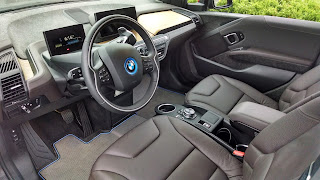
The car is holding up well and there are no squeaks or rattles to report. My interior still looks brand new, even with heavy use and high mileage for one year. I'm pointing that out because I have heard a few i3 owners report their leather seats showed premature wear, and even a couple people say the eucalyptus wood dash panels developing cracks (which BMW replaced under warranty). I have nothing negative or unusual to report on this though. Since I wrapped the car shortly after getting it, I can't really comment on how the exterior painted surfaces are fairing. Since this is the first BMW with all plastic body panels, and since BMW developed an entirely new way of painting the panels which uses 70 percent less water and 50 percent less energy than painting systems employed for their steel body panels, I think it's fair to wonder how well the painted panels will hold up over time. I have had a few people ask me how the wrap is doing and I can say that after a year of driving in New Jersey (including a harsh winter with a lot of snow and ice) the wrap is beginning to show signs of wear and even peeling on some of the corners. You really have to be looking at it hard to find the problem spots, but small issues are surfacing which I'm sure will only get worse. I really only intended to keep it wrapped for a year or so, so I'm not concerned. I figured this would happen after about a year. Just keep this in mind if you are planning to do a vehicle wrap.
 |
| The wrap is bubbling a bit on the side mirrors |
 |
| Wheel well beginning to peel |
 |
| The redesigned fuel sensor |
Over the year I had a couple of maintenance issues which needed service. The good thing was my dealer, JMK BMW, has i3s in their loaner fleet so I was able to drive an i3 even when my car was in for service, which amounted to a total of 14 days. The first issue was one that all the early i3's had, a blown onboard charger, or as BMW calls it, a KLE (Komfortladeelektronik or Comfort Charging Electronics in English). One good thing about the way BMW engineered the onboard charging is that there are two 3.7kW on board chargers, one in the main EME (Electrical Machine Electronics) and the other, the KLE, is installed separately from the EME. So if you do have a KLE failure, you can still charge the car, albeit at half speed. I can't give BMW a pass on this issue though. They had five years of field testing with the MINI-E and ActiveE, and to come out of the gate with a faulty on board charger is inexcusable in my opinion. To their credit, they quickly resolved the issue by re-engineering the KLE, and installing it in the existing i3 fleet. I've had the new KLE in my car for 10 months now, and it's been working fine. There was another issue that all i3's with the range extender had, which was a faulty fuel pressure sensor. Almost immediately after the i3 launched, REx owners were getting a Check Engine light, even if they never fired up the REx. It turned out a fuel pressure sensor was getting corroded by the gasoline used in the US. Evidently the mixture is different from the gas used in Europe where the i3 had launched 6 months earlier without this issue, and the additives in the US gas were creating havoc with the sensor. Again BMW quickly made a new fuel pressure sensor, this one actually has gold plated connectors to resist corrosion.
 |
| My battery pack dropped from the car. The heating element is inside, below the battery modules |
I also had a flaky
voltage regulator for the battery heating element which was occasionally sending an error message. I don't think BMW was sure if the sensor was bad or if the regulator was bad so they just replaced both. That required removing my entire pack to replace the regulator. I was surprised that this major service was accomplished by my dealer in less than two days. The only other issues I had were flat tires; four of them to be exact. It's difficult for me to really assess blame on this, since flat tires are usually the fault of the driver for running over debris or adverse road conditions, but four flats in one year is a little troublesome. Could it be related to the rubber compound Bridgestone used to make these unique tires, or related to how tall and thin they are? The two main problems I have with this are the fact that since the i3 doesn't have a spare, you are left stranded unless the mobility kit (an air compressor and tire sealant) can temporarily seal the hole and allow you to drive home or to a repair shop. Secondly, the tall thin tires are unique to the i3, so they aren't always in stock at the dealer. One time I had to wait four days for the dealer to get one.  |
| With no spare tire onboard, a flat means you're getting towed |
 |
| At least with a sidewall bubble you can drive to the dealer, but you still need to buy a new tire and hope it's in stock |
Three of the four flats I had were caused by sidewall bubbles, which happen when the inner liner of the tire is damaged. Sidewall bubbles typically happen when you hit a pothole, curb or road debris. In all three cases when I had this happen, I hit a good sized pothole and immediately figured I'd have a problem. Pulling over once it was safe confirmed what I had expected. The other flat I had was caused by a large metal screw. In that case I was actually only a couple blocks from a BMW dealer who actually had the tire in stock and I was able to wait there and drive off about an hour later. A few years back I had a Porsche Boxster with low profile Pirelli tires and had sidewall bubble issues with that car also, so I know this is something that is common with low profile tires. The difference was the car had a spare tire and the Pirellis were available everywhere. If I could go back in time I probably wouldn't have gotten the $1,300 optional 20" sport wheels and I certainly would have paid the $1,000 for the tire and wheel insurance. I definitely like the look of the 20" wheels, but they are lower profile than the 19" stock wheels, and that makes them more susceptible to bubbling.
 |
| 91 miles on a charge is my personal best to date |
As for the range, in warm weather (over 65 degrees) I can usually beat the EPA rated range of 72 miles per charge. In fact, I average about 78 miles per charge in these favorable conditions. The cold weather takes its toll and the worst range I ever got was 48 miles on a full charge before the REx turned on. This happened back in January when the temperature was below zero with ice covered roads and I didn't precondition the cabin or battery. I actually wanted to see just how bad the range could be in those conditions. However most of the winter when temperatures were under 30 degrees I averaged about 58 to 60 miles per charge. The furthest I ever drove before the REx kicked in was 91 miles, which I did shortly after taking delivery.I'll now list the top ten things I either find annoying, would like to see corrected or added features to future i3s.
1) Configurable regenerative braking. I'd like to select how aggressive or weak the regenerative braking is. Other manufacturers offer this and the owners I've spoken with appreciate having control over their regen. The i3's regen does increase in strength when in Eco Pro and Eco Pro+ modes, but I'd prefer the ability to manually adjust it. 2) The car needs an extension flaps on the sun visors. There is a huge gap between the visors and early morning drives can be difficult when heading East. 3) The charging connector needs to unlock from the vehicle when the charging session ends. BMW had said this would be part of the March 2015 software update (which I have) but it still doesn't work.  |
| The large gap between the visors allows the blinding sun to get through. Visor extension flaps would be appreciated. |
4) The front storage compartment (frunk) should be waterproof. If that is problematic then install a snap-on or hinged cover to keep dirt and water spray out.  |
| The current configuration allows leaves, water and dirt to get into the frunk storage compartment. Anything stored up there gets dirty and wet. A cover would solve the issue. |
5) Remove the annoying disclaimers and seat belt gong every time you turn the car on. The seat belt warning should give you ten or twenty seconds to buckle up before it sounds the alarm. I might code my car just to remove these.6) Fix the windshield wiper. It currently pulls water back into the drivers view when it changes direction. During heavy rains there is a significant obstruction to the drivers view of the left side of the windshield.  |
| The wiper leaves a line of water on the windshield, and actually pulls it back into the drivers line of vision when it changes direction. |
7) Add a battery temperature readout. BMW can bury it in iDrive if they don't want it on the main display screen, but put it somewhere. Many experienced electric vehicle drivers want to see their battery temperature.
8) Add a heated steering wheel. In my opinion heated seats and steering wheel should be standard on all EVs, especially ones from premium brands. I would have really appreciated it last winter.
9) Include an AM radio. Other EV manufacturers have figured out how to reduce the interference and offer it in their vehicles. I'm sure BMW can figure this out too, even if the reception isn't perfect.  |
| When the ACC disengages, you get this warning. The problem is by then it's already disengaged and the car is applying the regenerative braking. |
10) Fix the Adaptive Cruise Control and Parking Assistant. These are really great features, and this kind of technology is expected in a car like the i3. The problem is the ACC disengages suddenly and doesn't recognize certain vehicles because of their tail light configuration. The car will drive right into the rear of a Dodge Charger for instance, because the Charger's taillights (which extend across the entire rear of the vehicle) for some reason confuse the ACC. Direct sunlight and sometimes overpasses also cause the system to shut off without warning. I dedicated a post to this issue a few months ago. The Parking Assistant is an automated parking feature which does an incredible job of parking the i3 in very tiny parking spots. It only needs an opening which is 22 inches longer than the car to park it. The problem is, I've had numerous people report to me that the car rubbed the curb during the automated parking, scratching the rims. I've had enough people tell me this happened to believe it wasn't just a couple cars malfunctioning. I believe there is an inherent flaw in this feature which needs to be fixed, so for now I recommend not using the Parking Assistant until we get word that the issue had been corrected.
OK, so by now you must be thinking I must really hate the i3, considering all these things I've pointed out that I don't like. That wouldn't be correct. I actually love the car and wouldn't trade it for anything, but nothing's perfect, and BMW can definitely make adjustments which would improve the i3 in my opinion. Now I'll dive into my top ten i3 likes.
1) Spacious interior. For a car that is only 13 feel long, it has a lot of interior room. It actually has nearly the same interior volume as a 3-Series which is more than two feet longer than the i3. |
| Spacious, comfortable and well laid out. The i3's interior is definitely one of its strong points |
2) Beautiful interior. In my opinion the i3's interior is stunning and laid out perfectly. The seats are very comfortable and the outward vision is excellent.
3) It's incredibly fun to drive. The instant torque, combined with the light weight make the i3 the most fun to drive electric vehicle this side of a Tesla P85D. The low end acceleration (under 60mph) is fantastic and it's actually the fastest one of the fastest BMWs from 0-30mph. Somehow the tall, thin tires do their job and keep the car under control in hard turns. While it doesn't corner like an M3, it really does just fine when it needs to. I've let dozens of friends and family members drive it and they all walk away with an ear to ear grin. It's really a blast to drive.4) Futuristic, sustainable construction. I love the fact that I'm driving the only volume production to ever be constructed with a passenger compartment primarily made of carbon fiber reinforced plastic, an all aluminum frame and thermoplastic body panels. There is absolutely nothing else like it on the road today. Plus, every stage of manufacturing and assembly was developed with sustainability in mind.100% of the electricity used in the Leipzig assembly plant is derived from the wind farm BMW installed on the site. It actually generates so much excess electricity that BMW sells the excess to the Volkswagen AG. Even the carbon fiber plant in Moses Lake, Washington where the CF is made is powered 100% by renewable hydro-power.  |
| BMW's Leipzig plant where the i3 is made. The on site wind turbines produce more energy than the plant uses. |
5) The charging rate. I can consistently pull 7.2kW at home (30 amps @ 240v) and now that there are finally some CCS DC fast Chargers being installed I can look forward to fast charging on the go. I'll soon be installing a 24kW CCS DC Fast charger at my restaurant so I'll have access to it every day. One of the advantages of having a relatively small battery is it charges quickly! I can fully recharge in a little under four hours while charging level 2, and I can be at 90% in about three hours. Tesla is the only EV manufacturer in the US making on board charging equipment which can deliver more than 7.2kW from a level 2 (240v) source.
6) The efficiency. According to the EPA, the i3 is currently the most efficient car sold in America. Over the entire year I averaged 3.9 miles per kWh. In the warmer weather I'm usually around 4.5 mi/kWh and in the winter I was averaging about 3.5 mi/kWh. I should note that I don't drive the car softly, and I'm certain many other i3 owners see much better consumption figures. It's way too much fun to drive it like it was a Prius. Averaging 4 mi/kWh the i3 would cost the average American about $400 per year to drive 15,000 electric miles. |
| I needed to drive over 200 miles on the range extender when I drove it to Vermont last winter. I set the cruise control to 70 mph and the REx was able to sustain the charge level the entire trip without any issue, even with needing to make a few elevation climbs. |
7) The range extender. I know above I said I'd prefer a larger battery over the REx, but that just isn't an option at this time. As far as range extenders go, I like how BMW set this one up. It's truly an auxiliary power unit, one that has no physical connection with the wheels and cannot drive the wheels under any condition. It's sole purpose is to maintain the battery state of charge and allow the driver to continue along until they have the opportunity to plug in. You'd never buy an i3 REx and not charge it, simply driving on gas all the time. It's not meant to drive just as well on gas as it is on electric and I like that. It's an electric car with a secondary power source meant for occasional use, and in that vein it works perfectly - well for me at least. In all of my REx-ing, I never had the vehicle go into reduced power mode which can happen if you are using more energy than the 650cc engine can deliver. This can happen under long sustained hill climbing at highway speeds. BMW is currently working on a solution which will allow for more robust range extender use. This feature will be called Hill Climb Assist and will be available in the Fall. All current REx cars will get the update. There is another option which some owners have done, and that's coding the car to allow REx-on-demand. I have not done that to my car because the range extender has been able to do anything I've called for it to do so far, and I've found that as long as I set the cruise control for 70 mph or lower, I can drive indefinitely, provided I keep refueling every 60 miles or so. Probably the best thing I can say about the range extender is it's allowed me to never even think about my range anymore, I just get in the car everyday and drive.  |
| Resting at home. You can see the winter tire/wheel combo on the rack above the car. The Bridgestone Blizzak tires were excellent in the snow. I suspect this was an instance where the tall, thin tires actually improved the traction. |
8) The attention. Everywhere I go people stop and ask me about the car. I understand many people might not like that, but I do like talking about it and having a discussion about why they should consider driving electric too. I know there are people who think the i3 is ugly, but the response I get from the majority of people is they think it's cool. I don't think the i3 is the best looking car on the road, but I definitely don't see it as ugly and neither do most of the people who stop me to ask about it. When I'm working I can see it through the windows in the parking lot. Every day people walk up to it, look inside and many take pictures of it. Like it or not, it generates a lot of interest.
 |
| The i3's navigation "spider map" offers a pretty accurate visual display on the cars current range in the different driving modes. |
10) A lot of small things add up to really enhance the ownership experience. Besides the usual attributes expected in all electric vehicles like the quiet cabin and the smooth linear acceleration with instant torque, the i3 has some extras that really seem to make the whole car exceed the sum of its parts. I love the hill hold feature which keeps it from rolling like many other EVs do while stopped. The absence of artificial creep is a welcomed "addition" that some other EV manufacturers just don't seem to get. I've done more than one poll on this topic and the vast majority of people say they don't want artificial creep in their electric vehicle and BMW got this right. I love how the aggressive regen really allows "one pedal driving". While I did mention above that I wish the regen was adjustable, the level it's set at now is just about perfect for me in most driving conditions. Adjustable would be better, but as is the regen level is very good, probably the best of any electric vehicle in my opinion. The soft speed limiter helps to coach you to drive more efficiently if you want to, and the three different driving modes (Comfort, Eco Pro & Eco Pro+) gives the driver the ability to extend their range significantly. The "spider map" display in the navigation system shows how far the car can go in each driving mode, and alerts the driver if their selected destination is beyond the range, pointing them to possible charging stations along the desired route. The brake assist will sound an audible alert if it senses the car is rapidly approaching the vehicle in front of it and it will even apply the brakes automatically if you are going under 30 mph and it determines you are about to have a possible collision. I also really appreciate that most BMW dealerships now have i3s as loaner cars so i3 owners can continue to drive electric even if their car is in for service. Finally, the large center display screen is as crisp and clear as any I've seen. It is positioned so there is almost no glare issues and the HD rear view camera is television-quality clear.---------------------------------------------------------------------------------------
 |
| The "Secret Service Menu" shows I have 19.1 kWh available when fully charged |
So that pretty much sums up my thoughts after one year of ownership. I listed ten positives and ten negatives and hope the information above helps to paint a picture of what I believe are the i3's strengths and weaknesses. One more topic I'd like to touch on though is battery degradation. There are a lot of people curious about how well the battery is holding up over time and use. I'm going to be doing a more comprehensive post on this soon, but I'd like to at least mention what I've observed after 13 months and 27,000 miles. Fortunately, the i3 has a "secret service menu" in the OBC which allows the battery capacity to be displayed. While BMW officially states the i3 has a usable 18.8 kWh of the 21.6 kWh total battery pack, the service menu indicates we get a little more to access. An entire kWh more in fact. When new, the service menu shows approximately 19.8 kWh available. I've had others report seeing slightly less, but the majority of people who know how to access this info have told me the highest capacity figure they've seen was 19.8 kWh. I have been checking my capacity and watching it slowly decrease. It's currently showing that I have 19.1 kWh available, which would mean I've lost about 3.5% of my capacity in 13 months and 27,000 miles. I've plugged about 700 times during the year and virtually always charge to 100%. I'll be keeping an eye on this and will report back on the capacity loss here from time to time. |
| I have an 8.8kW solar array on my home in Chester, NJ. It generates most of the electricity I use for the house and charging needs. |
I'd like to also point out that during the year, BMW added a numeric state of charge display. This was something
I, and many other i3 owners asked for. It might seem like a minor detail, but what's most encouraging is BMW responded to their customer requests and through a software update added the SOC display. Of course there was always a SOC display there, in the form of a bar graph, but many people wanted to see it displayed more precisely, in a numeric value as well and BMW delivered. Now let's see if we can get the battery temperature display in year two...
 |
| By toggling through the OBC options, you can see the SOC of 47% in the upper left hand corner of the drivers display screen. |
In closing, the i3 pretty much ended up as I expected. It's far from perfect, but so is every other car I've ever driven. I wish it had a larger battery (or a larger battery option), a few monochromatic paint scheme options (like I did with the wrap), offered in a "sport" version with the coilovers that come standard in the Japanese market and a few other sporty upgrades and I think BMW needs to address the issues with the ACC and Parking Assistant features. I don't mind that the moonroof isn't available in the US, and the unconventional exterior styling doesn't bother me. I am much more concerned with the car's interior since that is what I interact with while driving. Speaking of driving, for me it really all comes down to that. The i3 delivers more fun than you should legally be allowed to have at 4 miles per kilowatt-hour.


